The Christa Pike Series
Christa Pike: When the Death Chart Became a Survival Chart
An Evolutionary Astrology Investigation into Mortality, Crisis, and the Possibility of Transformation
By Erin Light · Part One of a Two-Part Series
Introduction: When the Expected Ending Never Came
On September 30, 2026, Christa Pike was scheduled to be executed by lethal injection in Tennessee for the 1995 murder of 19-year-old Colleen Slemmer.
What followed was an extraordinary sequence of legal intervention, an attempted execution, a medical emergency, and an unexpected survival.
Pike received two rounds of the execution drug pentobarbital but remained alive. She was subsequently transported to a hospital, where she required intensive medical care.
On October 6, her attorneys publicly confirmed that she had regained consciousness and was speaking. The precise moment she regained consciousness has not been independently established.
For me, this case presented an unusual opportunity to examine one of evolutionary astrology’s most difficult questions:
When a chart contains symbolism traditionally associated with death, does it necessarily indicate physical death, or might it describe a profound confrontation with mortality that produces an entirely different outcome?
Before the execution, I had examined Pike’s natal chart alongside the transits for September 30.
Several planetary configurations concerned me.
There were strong eighth-house themes, a Mars–Pluto opposition, significant Saturn symbolism, and Uranus moving through the sixth house.
I questioned whether these configurations represented an actual death signature.
But I was not entirely convinced.
Something about the chart left the interpretation unresolved.
When Pike survived, I returned to the astrology, examining the transits for October 6.
What I discovered challenged my initial interpretation and raised a much larger question about how we understand planetary symbolism.
Establishing the Natal Chart
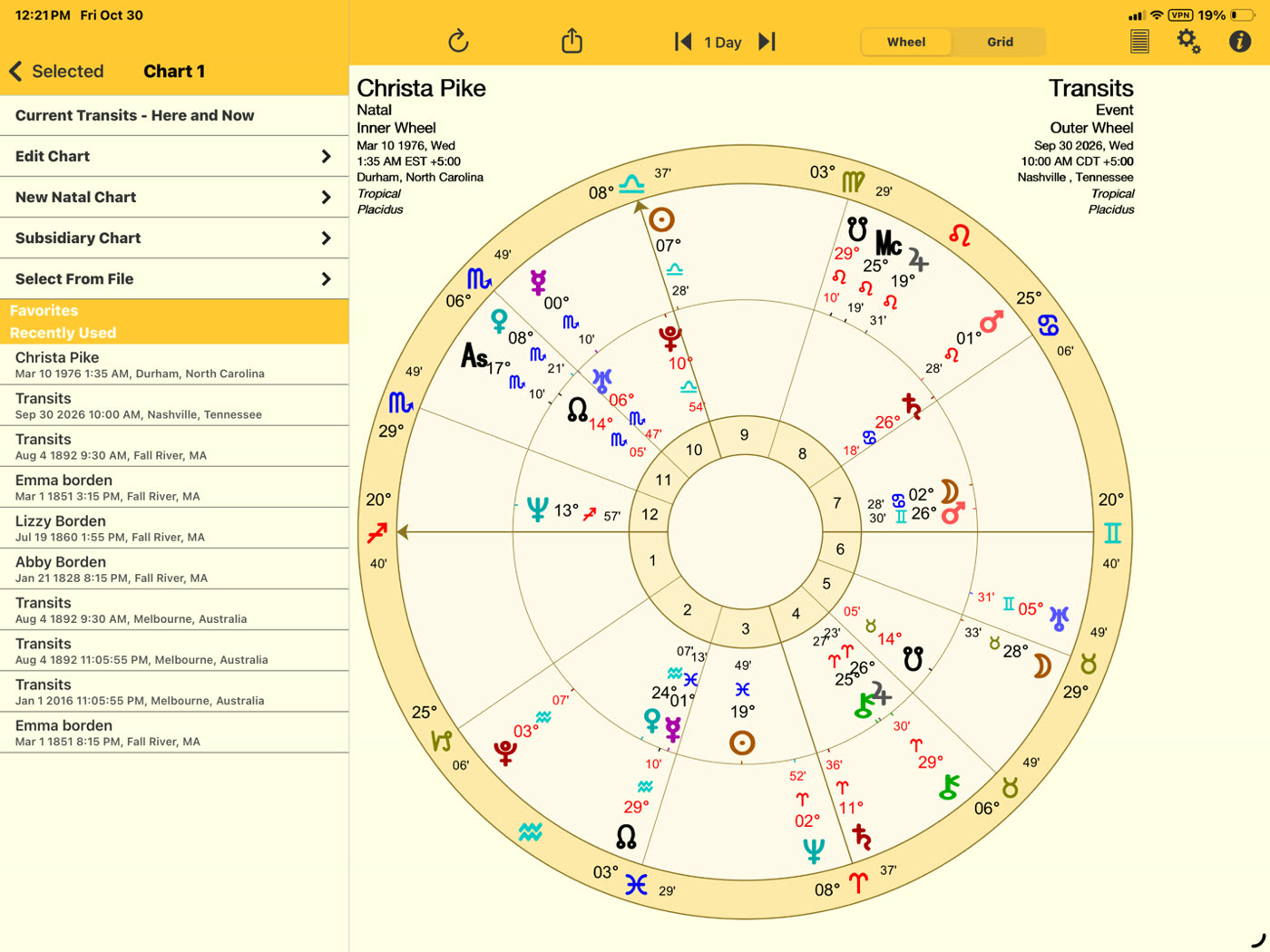
For this investigation, I am using a proposed rectified birth time of 1:35 a.m. on March 10, 1976, in Durham, North Carolina.
This is a working rectification rather than a documented birth time.
Using this chart, Pike has approximately 20 degrees Sagittarius rising.
Several natal placements are particularly relevant to this investigation.
Her natal Saturn is positioned at approximately 26 degrees Cancer in the eighth house. Natal Mars occupies approximately 26 degrees Gemini in the seventh house.
Natal Pluto sits at approximately 10 degrees Libra in the tenth house, while Uranus occupies approximately 6 degrees Scorpio.
These placements provide an interpretive foundation for examining relationships, consequences, mortality, and institutional authority.
However, because the birth time is rectified, the house placements remain provisional.
This distinction matters, particularly when examining an event as serious as a scheduled execution.
Saturn in the Eighth House: Mortality and Consequence
One of the first placements that drew my attention was natal Saturn at 26 degrees Cancer in the eighth house.
In traditional astrology, the eighth house has long been associated with mortality, death, inheritance, and matters beyond individual control.
Evolutionary astrology expands this symbolism to include psychological transformation, vulnerability, loss, and the consequences of deeply embedded patterns.
Saturn introduces responsibility, limitation, accountability, and the consequences of previous actions.
Cancer, meanwhile, concerns emotional security, belonging, family conditioning, and protective responses.
Saturn is traditionally considered in detriment in Cancer, although this does not automatically make the placement destructive.
Within an evolutionary framework, Saturn in Cancer may describe difficulties surrounding emotional security, attachment, responsibility, and the development of mature emotional boundaries.
Placed in the eighth house, these themes can become intertwined with profound crises and experiences involving powerlessness.
In Pike’s case, I considered this placement in relation to the consequences of her crime and the legal sentence imposed upon her.
But there was an important question.
Does Saturn in the eighth house represent physical death, or does it symbolize an unavoidable confrontation with consequences and transformation?
The distinction became increasingly important as I examined the transits.
September 30: The Mars–Pluto Opposition
On September 30, the transit chart we were examining placed Mars near 1 degree Leo and Pluto near 3 degrees Aquarius.
This formed an opposition with an orb of approximately two degrees.
In evolutionary astrology, Mars represents action, assertion, conflict, and the instinct for survival.
Pluto symbolizes power, control, destruction, transformation, and processes that challenge an individual’s sense of autonomy.
An opposition between these planets can symbolically describe an intense confrontation involving force and power.
In this particular chart, the opposition activated the second–eighth-house axis.
The second house concerns personal resources, physical security, and individual autonomy.
The eighth house concerns vulnerability, mortality, shared power, and circumstances in which control may be exercised by others.
The symbolism was striking in the context of a state execution.
Mars occupied the eighth-house side of the axis, while Pluto occupied the second-house side.
The configuration suggested a confrontation between individual survival and an external exercise of power.
Additionally, Mars at 1 degree Leo was approximately five degrees beyond Pike’s natal Saturn at 26 degrees Cancer.
Although this is an out-of-sign conjunction, it provided another possible connection between Mars, Saturn, and eighth-house symbolism.
These were among the configurations that initially made me question whether the chart indicated death.
However, an important principle emerged.
A powerful Mars–Pluto configuration may describe an extreme confrontation without determining its final outcome.
The opposition alone cannot establish whether someone will die, survive, or experience another form of crisis.
Uranus in the Sixth House: The Unexpected Medical Dimension
Another placement that caught my attention was transiting Uranus at approximately 5 degrees Gemini in Pike’s sixth house.
The sixth house is associated with health, illness, physical functioning, and treatment.
Hospitals and institutional confinement are also traditionally associated with the twelfth house, making it important not to assign all hospitalization symbolism exclusively to the sixth.
Uranus represents sudden developments, disruption, unpredictability, and circumstances that overturn established expectations.
During my broader examination of the September and October transits, I had repeatedly noticed Uranus appearing in connection with sixth-house health themes.
This became particularly interesting following Pike’s attempted execution.
The procedure did not produce the anticipated outcome.
Instead, she experienced a medical emergency and required hospital treatment.
Her attorneys subsequently described serious injuries, including burns and blistering to her arms.
From an astrological perspective, Uranus moving through the sixth house offered a symbolic correspondence with an unexpected medical development.
But Uranus did not explain why Pike survived.
The medical explanation remains a matter for clinical investigation and the official review.
What interested me was the difference between the symbolism of disruption and the assumption of death.
Uranus may signify a sudden change in circumstances.
It does not necessarily determine whether that change will be beneficial or destructive.
Mercury: From Libra into Scorpio
Another important transition involved Mercury.
On September 26, Mercury appeared near 26 degrees Libra in the charts I was examining.
By September 30, it had moved into the opening degrees of Scorpio.
This is ordinary forward movement through the zodiac, but the symbolism of the sign transition interested me.
Libra is traditionally associated with balance, judgment, competing interests, and questions of justice.
Scorpio concerns crisis, hidden processes, mortality, investigation, and transformation.
The movement from Libra into Scorpio therefore offered an interesting symbolic transition from legal deliberation toward an examination of what happens when a sentence is carried out.
The actual events followed an extraordinary legal sequence.
A federal appeals court temporarily stayed Pike’s execution, but the United States Supreme Court subsequently vacated that stay, allowing Tennessee to proceed.
The execution attempt later that evening resulted in an unexpected medical crisis.
Mercury’s sign transition provides a symbolic way to discuss the movement from legal judgment toward investigation.
However, it would be inaccurate to claim that Mercury caused those events or that its movement independently predicted them.
October 6: A Different Astrological Picture
When I returned to the chart for October 6, several configurations had changed.
The Mars–Pluto opposition remained active but was separating.
Mars had advanced to approximately 4 degrees Leo, while Pluto remained near 3 degrees Aquarius.
The opposition was now approximately one degree beyond exactness.
The confrontation represented by Mars and Pluto had not disappeared, but the aspect had moved beyond its peak.
More importantly, the Moon had entered Leo.
In the October 6 reference chart, the Moon appeared near 23 degrees Leo, with Jupiter near 20 degrees Leo.
Both occupied the eighth house of Pike’s proposed natal chart.
This produced a Moon–Jupiter conjunction with an orb of approximately three degrees.
For me, this was one of the most interesting developments in the comparison.
The Moon–Jupiter Conjunction: Reprieve Within the Eighth House
The eighth house remained activated.
But the planetary symbolism had changed.
On September 30, I had been examining Mars, Saturn, and Pluto in relation to mortality, force, and consequences.
By October 6, the Moon and Jupiter were conjunct in the same house traditionally associated with death and profound transformation.
The Moon represents emotional experience, physical rhythms, instinctive responses, and changing circumstances.
Jupiter is associated with expansion, opportunity, protection, meaning, and the possibility of growth.
In some astrological traditions, Jupiter is considered a benefic planet.
When the Moon and Jupiter come together, their symbolism may be interpreted as emotional expansion, renewed possibilities, or support during difficult circumstances.
Within the eighth house, this conjunction presented an intriguing contrast.
The house associated with mortality now contained planetary symbolism that could also be interpreted as reprieve.
Could this represent a second opportunity emerging from a confrontation with death?
That was the question I began asking.
Importantly, the Moon–Jupiter conjunction does not establish that Pike’s survival was astrologically predetermined.
Nor can it demonstrate that Jupiter protected her from death.
But as an evolutionary astrology interpretation, it offered a different way of understanding the eighth house.
The eighth house does not exclusively represent physical death.
It also represents transformation.
And transformation can occur when an individual survives an experience that fundamentally changes the circumstances of their life.
Mercury Conjunct Natal Uranus: An Unexpected Public Development
Another significant configuration appeared in the October 6 chart.
Transiting Mercury had advanced to approximately 7 degrees Scorpio.
Pike’s natal Uranus occupied approximately 6 degrees Scorpio in the proposed tenth house.
This created a conjunction with an orb of approximately one degree.
Mercury represents information, communication, documentation, and decisions.
Uranus represents disruption, unexpected developments, and sudden changes.
The tenth house concerns public institutions, authority, reputation, and matters that attract public attention.
The symbolism was particularly interesting because October 6 was also the date on which Pike’s attorneys publicly confirmed that she was conscious and speaking.
What had initially been understood as an execution had become an extraordinary medical and legal controversy.
The Mercury–Uranus conjunction provides an interpretive connection between unexpected information and institutional developments.
Again, the astrology does not establish causation.
But it offers a framework for examining how the public understanding of an event can change rapidly.
The Difference Between an Event and Its Outcome
One of the most important lessons I take from this investigation concerns the distinction between an astrological event signature and the eventual outcome.
When I initially examined September 30, the chart contained several configurations that could reasonably be interpreted, within traditional astrological symbolism, as involving mortality and crisis.
Mars opposed Pluto.
Mars was close to natal Saturn.
The eighth house was activated.
Uranus occupied the sixth house.
These configurations seemed consistent with an extreme event involving physical vulnerability and institutional power.
But they did not establish that physical death would occur.
After Pike survived, the October 6 chart offered a different symbolic emphasis.
The Mars–Pluto opposition was separating.
The Moon and Jupiter were conjunct in the eighth house.
Mercury was conjunct natal Uranus in the tenth house.
The same natal chart was now being examined against a different set of transits.
What changed was not the underlying natal symbolism, but the planetary relationships and the circumstances being interpreted.
This raises an important methodological question.
Are astrologers sometimes too quick to interpret mortality symbolism literally?
Perhaps an eighth-house activation describes the experience of confronting mortality rather than the certainty of death.
Perhaps Pluto represents the destruction of an expected outcome rather than the destruction of a physical life.
Perhaps Saturn represents consequences that continue beyond an anticipated ending.
These possibilities deserve careful examination.
The Human Reality Behind the Astrology
It is essential to recognize that this investigation concerns real people and profound suffering.
Colleen Slemmer was murdered in 1995, and her family has lived with the consequences of that crime for more than three decades.
Pike’s conviction and sentence arose from that murder.
Her unexpected survival does not diminish the seriousness of the crime or the suffering experienced by Slemmer’s family.
At the same time, the circumstances of the attempted execution raise separate questions concerning medical procedures, state responsibility, and the treatment of prisoners.
Following the failed execution, Tennessee Governor Bill Lee ordered an independent review and halted the state’s remaining scheduled execution for 2026.
On October 30, Pike released her first public statement since the attempt, describing continuing physical and emotional pain and uncertainty about her future.
Her survival has not resolved the legal questions surrounding her sentence.
These developments demonstrate that the consequences of September 30 extend well beyond the original execution date.
Evolutionary Astrology: Transformation Without Physical Death
Evolutionary astrology places particular emphasis on the development of consciousness through experience.
Within this framework, Pluto is frequently associated with profound transformation and the confrontation of deeply rooted patterns.
Saturn concerns responsibility, consequences, and the development of maturity.
Uranus challenges established structures and introduces unexpected possibilities.
Jupiter concerns meaning, expansion, and opportunities for growth.
When these symbols appear during an extreme life event, it can be tempting to assign a definitive outcome.
But perhaps their greatest interpretive value lies in examining the nature of the experience rather than attempting to predict its conclusion.
Pike’s case illustrates this difficulty.
The September 30 chart contained symbolism consistent with an extreme confrontation involving mortality, force, and institutional power.
The October 6 chart contained symbolism that could be interpreted as reprieve, unexpected developments, and continued transformation.
Neither chart independently proves what would happen.
Together, however, they provide an interesting case study in how astrological interpretations can evolve as events unfold.
Conclusion: When the Death Chart Became a Survival Chart
When I first examined Christa Pike’s September 30 transits, I questioned whether the planetary configurations represented physical death.
The Mars–Pluto opposition, Saturn’s eighth-house placement, and Uranus transiting the sixth house all suggested an extraordinary crisis.
But I remained uncertain about the outcome.
When Pike survived, I returned to the astrology.
By October 6, the Mars–Pluto opposition was separating, while the Moon and Jupiter formed a conjunction in the eighth house.
Mercury had also reached a close conjunction with natal Uranus in the tenth house.
The symbolism had shifted.
What initially appeared to be a chart dominated by mortality and confrontation could now be examined alongside themes of survival, reprieve, and unexpected transformation.
This does not mean astrology predicted Pike’s survival.
Rather, the comparison highlights an important limitation in interpreting difficult planetary configurations.
A chart may symbolize a confrontation with death without establishing that death will occur.
For evolutionary astrology, that distinction is significant.
Transformation is not always synonymous with physical death.
Sometimes the expected ending does not arrive.
And when it doesn’t, the experience may raise questions that are even more profound than those we originally set out to answer.
Christa Pike’s case leaves us with one such question:
When an individual survives an experience that was intended to end their life, does the symbolism of death become the symbolism of transformation?
That question leads into the second article in this series, where I will examine the Sagittarius archetype, Pluto, collective responsibility, and the broader debate surrounding capital punishment.
Erin LightCosmic Clocks — Evolutionary Astrologycosmicclocksastrology.com